
When Is Cognitive Offloading Benign?
The debate about AI in universities is about which tools to adopt and how to stop students cheating with them. Both leave a harder question unasked: what happens to human agency once AI is good enough to do the cognitive work a degree exists to build? This note gives a test that decides, per task and per person, when handing work to a system augments and when it erodes. The same test explains how a human overseer can hold the form of control without its substance.
Good enough is the problem
Once a system can draft a literature review that reads as though a scholar wrote it, or produce feedback hard to tell from a supervisor’s, people stop doing the cognitive work a university exists to develop. Each step of the stopping is reasonable. Delegation is the efficient choice every time, and after a short period of assistance the unaided version of the task feels harder than it did before. The result is a spiral: less practice, less competence, a wider gap to the system, more delegation. Nothing malfunctions along the way. The outputs are good and the student is satisfied, which is why the erosion goes unnoticed.
Three ways competence fails
In the professions, automation erodes a competence that already exists. Endoscopists who had worked with AI support for months detected fewer adenomas when they worked unaided again. That is deskilling, and it leaves a decline to measure.
Students are forming competences rather than maintaining them. A student who has AI structure their arguments from the first semester never develops the capacity for independent argumentation. There is no decline, only an absence, and the metacognitive awareness that would notice the gap is part of what never formed. Medical educators have named this never-skilling. A third mode, mis-skilling, installs the wrong competence: the learner absorbs the model’s errors as correct and practises them with confidence. Each mode has its own detection logic, which matters for anyone trying to measure what AI does to learning.
The benign-offloading test
Writing offloaded memory and the calculator offloaded arithmetic without hollowing out the disciplines that adopted them. The useful question is when offloading is safe, and that is decidable. Offloading a cognitive operation is benign only when three conditions hold together.
- The operation is not what the task exists to teach. Offloading the skill being built is never benign. Offloading the scaffolding around it can be.
- The person is above the mastery threshold for it. Someone who can perform and evaluate the operation unaided can delegate it and take it back. Someone who cannot is skipping the work, and only they are exposed to never-skilling.
- The coupling is reliable and inspectable. A model that produces fluent errors without provenance cannot be trusted on retrieval the way a notebook one wrote oneself can.
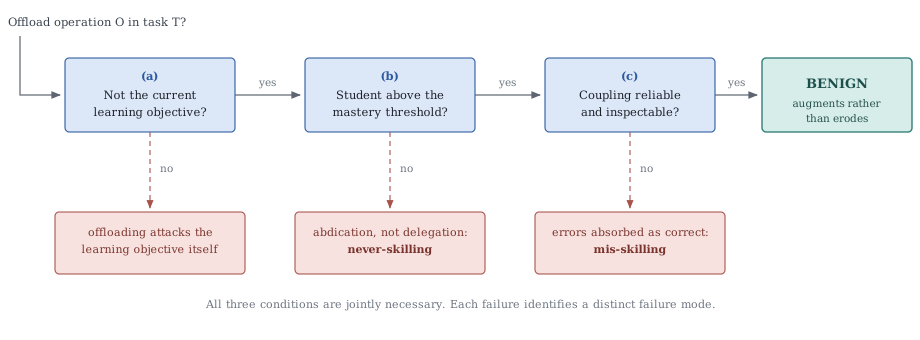
Each failure is diagnostic. Fail the first condition and the offloading attacks the learning objective. Fail the second and the result is never-skilling. Fail the third and the result is mis-skilling. That correspondence is what makes it a test rather than a checklist: it says what went wrong and therefore what to repair. Change the task, gate the tool until the competence exists, or make the output checkable. Most everyday use of a capable assistant fails at least one condition. The test is meant to discriminate.
The overseer who never learned
The EU AI Act classifies AI in education as high-risk and requires effective human oversight. The overseer must understand the system’s limits, detect anomalies, interpret outputs and decide to override them. Every one of those verbs presupposes a competence, and for students that competence is exactly what routine AI use prevents from forming. Oversight that presupposes competence cannot be the remedy for a process that removes it. A never-skilled overseer supplies the seat the regulation demands and none of the judgment.
The Act’s machinery of conformity assessment, logging and incident reporting is built for failures that are visible after the fact. Agency erosion produces none. A regime certified on today’s overseers says nothing about what routine use does to them, or about who fills the seats in two years.
This is where the argument meets COAI’s current programme. We model how control over networks of AI agents fails and test which safeguards hold. Every control chain we study ends at a person who has to notice, understand, decide, intervene and reverse. The competence of that person is a condition in the threat model like any other, and it is the one that erodes between tests.
The full argument, with the evidence and the agency model behind the test, is in Human Agency in AI-Mediated Higher Education: When Is Cognitive Offloading Benign?, accepted for the 25 Jahre Wirtschaftsinformatik Symposium in Heilbronn on 13 October 2026 and forthcoming in the GI Lecture Notes in Informatics. The idea was also discussed on the AI-in-education panel of the Human-AI Collaboration Summit in Warsaw in September 2026.